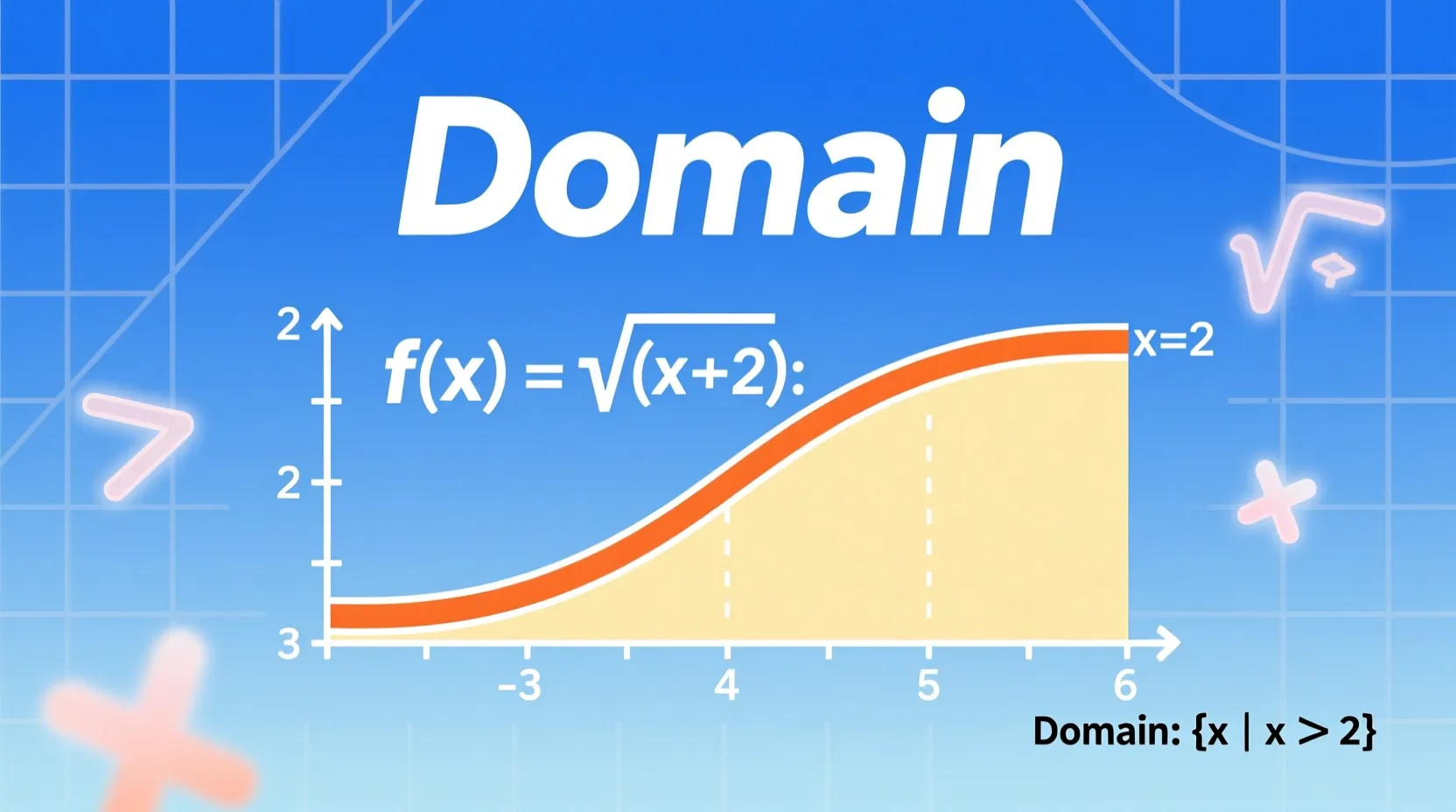
Ever stared at a math problem and saw the word domain pop up, and suddenly your brain froze like your WiFi on a rainy day?
Same. The first time I saw “Find the domain of the function…,” I thought it was talking about websites. Spoiler: it wasn’t.
But once you get the real meaning, it actually becomes super simple almost satisfying.
Quick Answer: Domain in math means “all the possible input values (x-values) a function can take.” It’s a straightforward, academic, and neutral term used in math classes, textbooks, and equations.
What Does Domain Mean in Math?
In simple words, the domain of a function is the complete set of all x-values you’re allowed to plug into a function without breaking the rules.
Think of it like a list of all the values a function accepts — anything outside that list would make the function undefined.
Example:
If the function is f(x) = 1/x, the domain is all real numbers except 0, because dividing by zero is impossible.
In short: Domain = all allowed x-values = all valid inputs.
Where Is “Domain” Commonly Used?
You’ll see domain in:
- 📚 Math classes
- 🧮 Algebra homework
- 📐 Graphing functions
- 🎓 Exams and textbooks
- 🧑🏫 Teacher explanations
- 💻 Online math tools or graphing apps
It is not slang, not casual, and not used in texting. It’s a strictly academic term used in math-related contexts only.
Examples of “Domain” in Conversation
A: what’s the domain of this function again?
B: all the x-values it can take without problems
A: can x be 0 here?
B: nope, 0’s not in the domain
A: how do i find the domain fast?
B: check for division by zero or negatives under square roots
A: is the domain all real numbers?
B: yep, unless something restricts it
A: what if there’s a square root?
B: then the domain includes only values that make the inside non-negative
When to Use and When Not to Use “Domain”
When to Use
- ✅ In math homework
- ✅ While solving functions
- ✅ When discussing equations
- ✅ In academic explanations
- ✅ In graphs and analysis
When Not to Use
- ❌ In casual texting
- ❌ In jokes, flirting, or social media captions
- ❌ In non-math conversations
- ❌ When talking about website domains (different term)
- ❌ In any informal context
Comparison Table
| Context | Example Phrase | Why It Works |
|---|---|---|
| Math Class | “The domain includes all real numbers except zero.” | Clear academic explanation |
| Homework | “I need to find the domain before graphing.” | Correct mathematical usage |
| Study Group | “What’s the domain of this function?” | Relevant to math discussion |
| Website Talk | “Register your domain name.” | Different meaning (web, not math) |
Similar Words or Alternatives
| Term | Meaning | When to Use |
|---|---|---|
| Range | All possible output (y-values) | When describing results of a function |
| Function | A rule that assigns each input one output | General math discussions |
| Interval | A continuous portion of numbers | When describing domain intervals |
| Real Numbers | All rational + irrational numbers | When defining domain values |
| Undefined | When a function cannot take a value | Explaining restricted domains |
| Inputs | Values put into the function | Simple explanation for beginners |
FAQs About the Domain in Math
What is the easiest way to find a domain?
Look for values that cause math errors: dividing by zero or taking square roots of negative numbers.
Is the domain always all real numbers?
No. It depends on the function. Some allow all numbers; others restrict certain inputs.
Is domain the same as range?
No. Domain = inputs. Range = outputs.
Why is the domain important?
Because it tells you which values make the function work correctly.
Can negative numbers be in the domain?
Yes unless the function restricts them (like square roots or logs).
Conclusion
Understanding what domain means in math is one of the most important basics in algebra and functions. It simply refers to all the valid x-values you can use without breaking the function.
Once you know how to spot restrictions like division by zero or square roots of negative numbers finding domains becomes easy and intuitive.
You’re graphing, solving, or analyzing equations, mastering the domain helps you solve problems correctly and confidently.

Welcome to ReplyResponses.com, your go-to hub for quick, witty, and clever replies for every situation! Whether you’re looking to spice up your chats, craft the perfect comeback, or make your messages stand out, we’ve got you covered. From funny one-liners to smart responses, our platform helps you communicate with confidence and flair. Get ready to never run out of words again—because every conversation deserves the perfect reply!